Cubby houses with slides in Australia: what to check before you buy
This page may contain affiliate links. See our affiliate disclosure.
A slide turns a cubby from a quiet hideout into the busiest spot in the yard. It also adds height, speed and a landing zone, so it deserves a closer look than a plain ground-level cubby. This guide covers what to check on a cubby house with a slide, using guidance from Kidsafe, the child safety organisation, and sources we link below.
We have not tested individual products, and we do not publish prices or invented specifications. Check the maker’s instructions for the product you are considering.
Who is a slide cubby for?
Use the maker’s age range as your starting point. A cubby with a slide often has a raised deck, so it suits kids who can climb a ladder and sit on a platform safely. For toddlers, a simple ground-level playhouse or a low slide may be a better fit. See Best cubby houses in Australia: how to choose one that lasts for the overall options.
What Kidsafe says about slides
Kidsafe’s backyard play guidance for slides includes the following points:
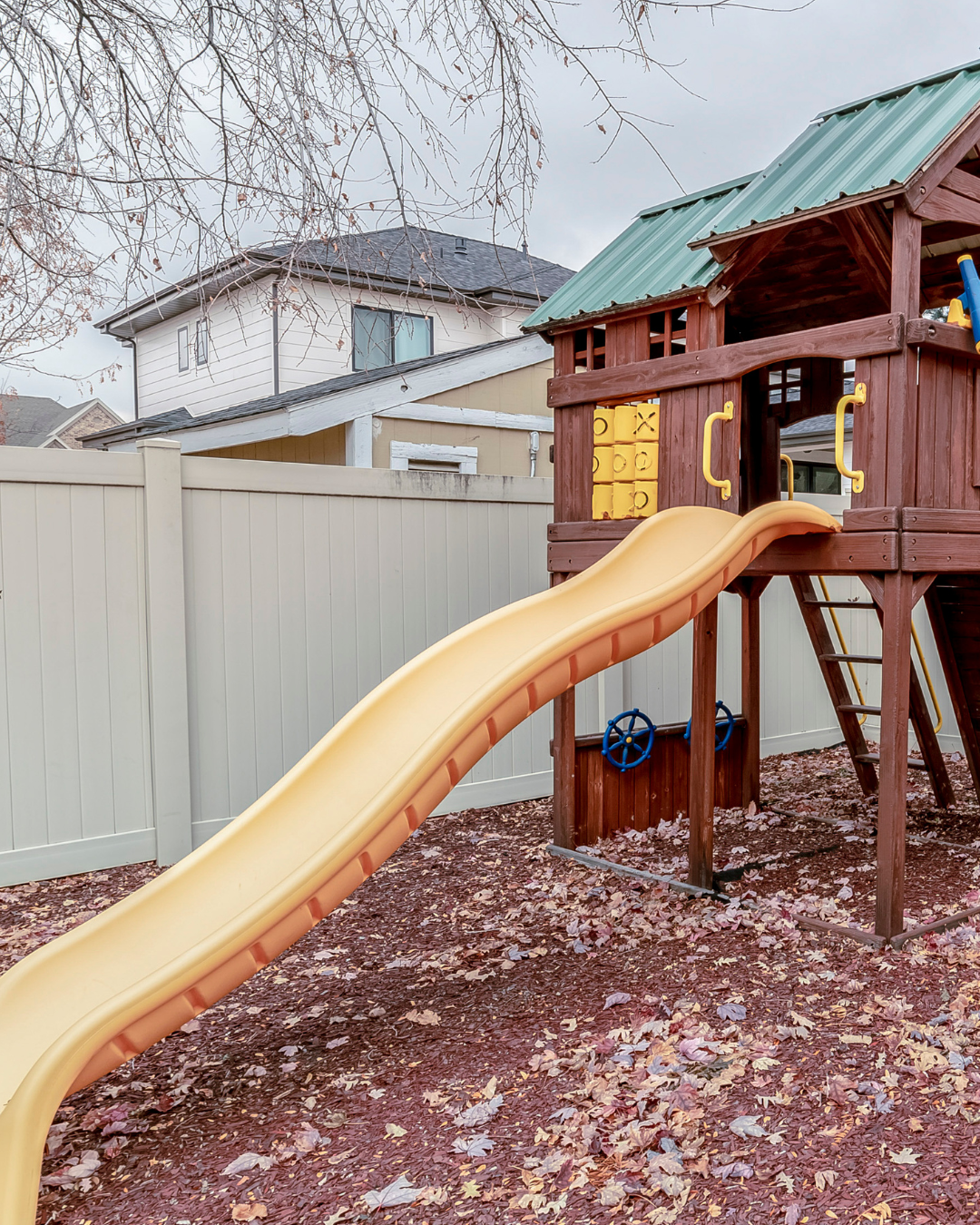
- Avoid metal slides, because they can reach high temperatures in sunlight. Choose plastic or fibreglass and provide shade over the sliding surface.
- There should be no gaps that could trap clothing, hair or fingers on the way down, so check carefully at the starting point.
- Leave a clear area to either side of the slide and around the base, and position the slide away from fences and other play equipment.
- Provide impact-absorbing surfacing around the end of the slide and to the sides.
- Make sure there is a platform at the top so a child can move easily from standing to sitting.
- For slides over 1 m high, there should be handrails or a crossbar at the entrance.
- Check slide attachments and the sliding surface regularly. Fibreglass slides may start to splinter over time.
- Always supervise children.
These are general guidelines from a parent’s guide, not a substitute for the maker’s instructions.
Heat is a real issue in Australia
A slide in full afternoon sun can be too hot for bare skin, even when it is plastic. Place the cubby so the slide is shaded for most of the day, or add a shade sail. Check the surface with your hand before kids use it, and keep shoes handy for the walk back.
Height and fall safety
Kidsafe advises that play equipment should not exceed 1.8 m in height for younger children and 2.5 m for older children. The higher the platform, the more important the surfacing and the guardrails. Kidsafe says elevated platforms should have guardrails or barriers, and that ladders and platform steps should be securely attached. Our guide to Elevated cubby houses in Australia: platform height, safety and surfacing goes further on this.
For surfacing, Kidsafe recommends impact-absorbing material under and around any elevated or moving equipment, such as shredded bark mulch, wood chips or non-compacting sand at a minimum depth of 30 cm. It also says play equipment should never be used on hard surfaces such as concrete or bricks. See Cubby house surfacing and fall safety: mulch, sand and soft-fall in Australia.
Space: the slide is longer than you think
A slide pushes the footprint out well beyond the cubby. You need the cubby, the slide, the landing zone and clear space to the sides. This is why slide cubbies suit larger yards better than small ones. If your block is tight, see Cubby houses for small yards in Australia: what fits and what to skip before you choose.
Check the build quality
- Platform. Level, solid, with no gaps that trap limbs.
- Guardrails. Vertical rails rather than horizontal ones are less climbable. Kidsafe SA recommends vertical guardrails with a height of 600 to 900 mm.
- Ladder or steps. Firmly attached, with no loose rungs.
- Slide attachment. Check that the slide is firmly fixed to the platform and that the join has no gaps.
- Roof. The design should not make it easy for children to climb onto the roof.
- Timber. Smooth, dressed timber, with fixings flush or countersunk. See Cubby house timber treatment and termites: what to ask and what to check.
Where to look
Retailers that list cubby houses with slides or slide add-ons on their Australian sites include Lifespan Kids, which lists elevated cubby houses with slides in its cubby range, and Yardgames, which lists play slides and slide attachments separately. You can see the Lifespan Kids range, the Yardgames slides and the Yardgames wooden play centres. On Amazon Australia you can search cubby houses with slides. Always check that the product, including the slide, is intended for outdoor home use and the age of your children.
Assembly and installation
Slide cubbies usually have many parts and need more than one adult. Set aside a full weekend, check that all the parts are present before you start, and follow the order in the instructions. You will probably want a cordless drill, a spirit level and a socket set. See Cubby house assembly tips: how to put a kit together without the stress. Anchor the cubby if the maker says to, and check all the fixings again after the first few weeks of use.
Ongoing checks
Once a month, run through a quick routine:
- Check the slide surface for cracks, splinters or heat damage.
- Check that the slide is still firmly fixed to the platform.
- Tighten loose bolts and screws.
- Check guardrails and the ladder.
- Top up the surfacing so it stays at the right depth.
- Look at the timber for splits, splinters and signs of termites.
See How to paint and maintain a cubby house in the Australian climate for the timber routine.
Is a slide cubby worth it?
For many families the slide is what keeps a cubby in use for years. It does add cost, space and safety checks. If you are on the fence, a ground-level cubby with a separate, low-height slide set can be a simpler way in. Either way, work out where the surfacing will go before you buy.